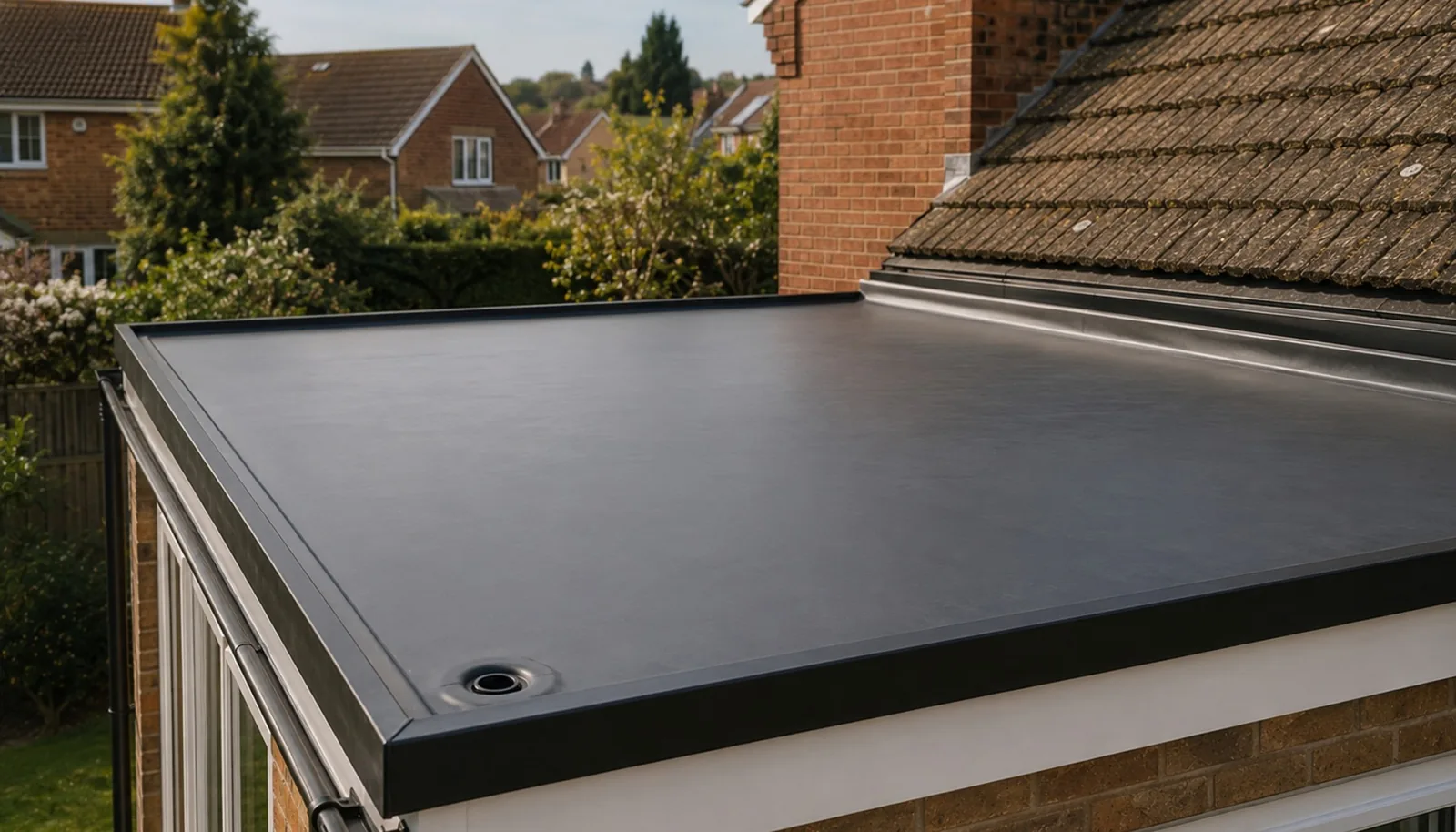
Flat-roof guidance
Flat roofs depend on a complete weathering system: surface, falls, outlets, edges, upstands and penetrations all work together.
Ask about a flat roof · View flat-roof services
Maintenance begins with safe observation and a clear record. Do not walk on a roof merely to inspect it. Roofs can be fragile, wet, damaged or unable to support casual access, and an unprotected edge creates a fall risk.
Know the roof covering
Common domestic systems include:
- reinforced bituminous felt;
- EPDM rubber membrane;
- GRP fibreglass;
- other proprietary liquid or sheet systems.
They have different joints, trims and repair methods. A patching material that suits one system may not bond correctly to another.
Observe after ordinary rain
From a safe viewpoint, look for:
- water remaining around outlets or local depressions;
- blocked grates or visible leaf build-up;
- lifted edges or trims;
- open laps, splits or punctures;
- surface blisters or ripples that have changed;
- movement around pipes, walls or rooflights;
- internal staining after rainfall.
Some water may remain temporarily, and appearance alone is not a diagnosis. Repeated ponding, change over time or water beside a defect is more useful evidence.

Keep drainage routes effective
Outlets, gutters and downpipes need to receive and carry the roof water. Debris at an outlet can create deeper ponding and push water towards vulnerable details.
Arrange safe clearance where required. Do not reach across an edge, step onto a rooflight or use a pressure washer on the covering.
Watch the perimeter and upstands
Edges, wall junctions and penetrations are common stress points. Check for:
- trims that have loosened;
- sealant that has split where sealant is part of the specified detail;
- membrane pulling away from an upstand;
- cracked surface around a penetration;
- poor or altered flashing above the roof.
Applying general-purpose sealant over the visible line rarely resolves an unsuitable underlying detail.
Avoid accidental damage
Roofs can be punctured or worn by:
- unplanned foot traffic;
- dropped tools;
- stored materials;
- sharp debris;
- ladders placed directly on an edge;
- later services fixed through the covering.
If another contractor needs access, agree protection and responsibility for penetrations before work begins.
Record the installation and repairs
Keep useful information such as:
- covering type and approximate installation date;
- product or installer records where available;
- photographs of outlets and perimeter details;
- dates of leaks, storms and repairs;
- changes made by later trades;
- any maintenance or guarantee conditions supplied.
Do not claim a guarantee or remaining service life without the supporting document.
When prompt assessment is sensible
Arrange timely review when:
- water is actively entering;
- a split, puncture or open lap is visible;
- an edge has lifted after wind;
- a soft or moving area is apparent;
- staining repeatedly returns;
- an outlet is damaged or cannot carry water;
- rooflight or wall details have opened.
Keep people away from a bulging ceiling or unstable area below.
Repair or replacement?
A local repair may be reasonable where the defect is isolated and the surrounding system remains sound. Wider renewal may be more appropriate where failures are widespread, the deck is damaged, falls are poor or repeated patches no longer provide a dependable result.
Building Regulations may apply to renovation or replacement of a thermal element. The proposed scope should be checked rather than assuming a like-for-like covering change is exempt.