Masonry guidance
Some old joints remain serviceable for decades. Repointing should follow the material that has genuinely failed, not a salesman's square metre target.
Ask about repointing · View masonry services
Mortar fills the joints between bricks or stones, helps shed weather and is usually intended to accommodate some movement and weathering before the masonry itself is sacrificed.
A wall does not need repointing merely because the mortar is not new or perfectly uniform. The question is whether the joints still protect and support the masonry.
Signs of genuine failure
Look from a safe position for:
- mortar missing deeply from joints;
- loose material that powders or falls out with light contact at ground level;
- open gaps around brick edges;
- cracks passing through the joint;
- erosion severe enough to expose vulnerable brick surfaces;
- damp or plant growth concentrated in failed joints;
- loose masonry where support has been lost.
Dark staining, old colour variation and shallow weathering do not automatically mean wholesale failure.
Why joints fail
Mortar can deteriorate through ordinary weathering, repeated saturation, frost, movement, salts, poor original work or an incompatible previous repair.
Check for causes above and below:
- overflowing gutters and downpipes;
- failed copings or sills;
- leaking pipework;
- cracks around openings;
- raised soil or paving;
- hard cement patches beside softer original mortar.
The danger of a hard or thin surface patch
Smearing a thin mortar layer over an existing joint is sometimes called ribbon or strap pointing. It may look fresh briefly but has little depth to bond and can trap water at its edges.
A very hard mortar used with soft or historic brick can force weathering into the brick faces. The replacement mortar should be compatible with the wall rather than chosen solely for speed.
What proper repointing involves
- Identify the failed area and any water source.
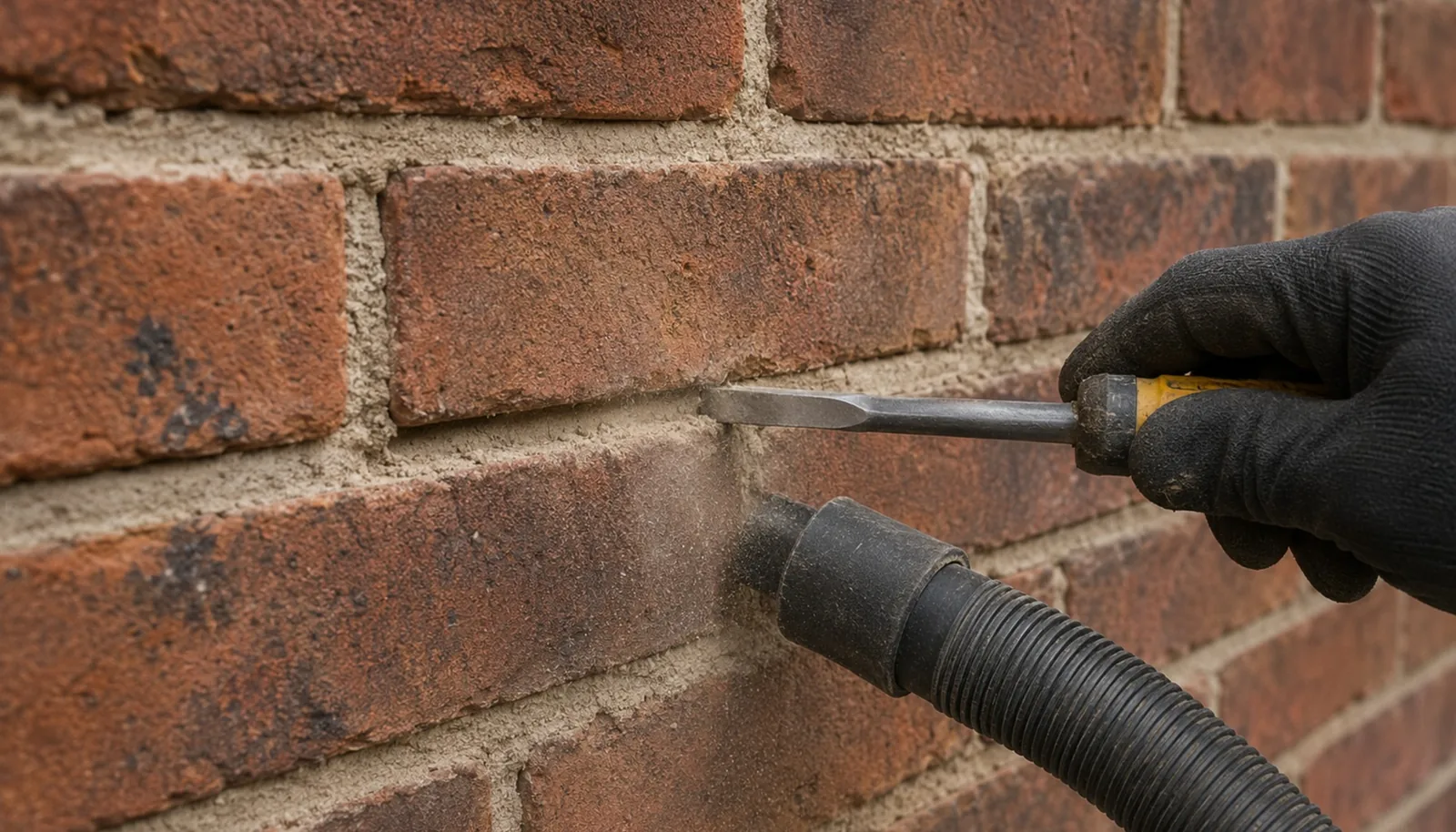
- Remove defective mortar carefully without widening joints or damaging brick edges.
- Clean loose material and prepare the joint.
- Select a compatible mortar and suitable aggregate.
- Fill and compact the joint through its prepared depth.
- Finish the profile to suit the wall and exposure.
- Protect fresh work from unsuitable sun, rain, wind or frost.
- Leave brick faces clean.
Local repointing or the whole elevation?
Local repair can be sensible where failure is isolated. A larger area may be justified when joints are consistently open or previous incompatible work has affected the elevation.
The edge between new and old work should be chosen thoughtfully. A perfect colour match may not appear immediately because fresh mortar changes during curing and weathering.
Older and listed buildings
Traditional walls often need lime-based or otherwise compatible mortars. Listed buildings and walls in conservation settings may require consent or specialist conservation advice. Aggressive power tools and acid cleaning can cause irreversible damage.
Cracks need a separate look
Repointing is not a structural diagnosis. Stepped, widening or recurring cracks; bulging walls; movement around openings; or displaced masonry may need a structural engineer.
What not to do
- Do not pressure-wash weak joints.
- Do not grind deeply into brick edges for speed.
- Do not assume the strongest mortar is the best.
- Do not repoint a saturated or frozen wall.
- Do not cover active movement with a cosmetic joint.
- Do not treat mortar colour alone as failure.
Questions about old pointing
Can I test mortar with a screwdriver?
Avoid damaging the wall. Gentle ground-level observation may show loose material, but a contractor should assess the extent and suitability of removal.
Why are brick faces flaking beside hard joints?
Moisture and frost can concentrate in softer masonry when the mortar is unusually dense or hard. Other exposure factors may also contribute.
Will repointing cure penetrating damp?
It can repair one route, but roofs, gutters, render, openings and condensation should also be considered. Damp needs diagnosis, not a single favourite answer.
How long before the colour settles?
Curing, drying and weathering take time. The exact change depends on the mortar and conditions.
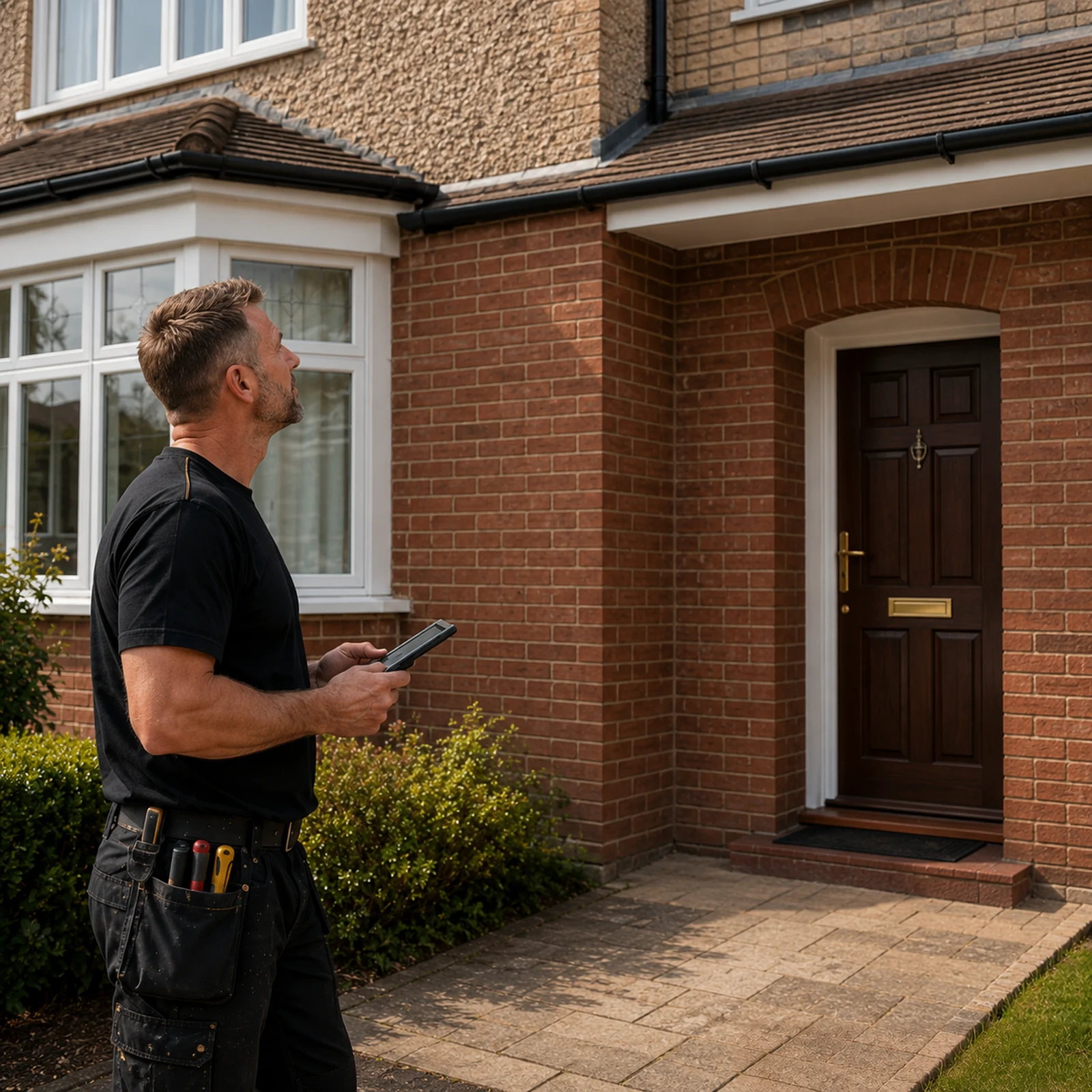
Photograph the full elevation
Include the roofline, openings, base and close details of representative joints.